
What Is Argentine Tango? Understanding the Authentic Dance From Argentina
Aug 21, 2026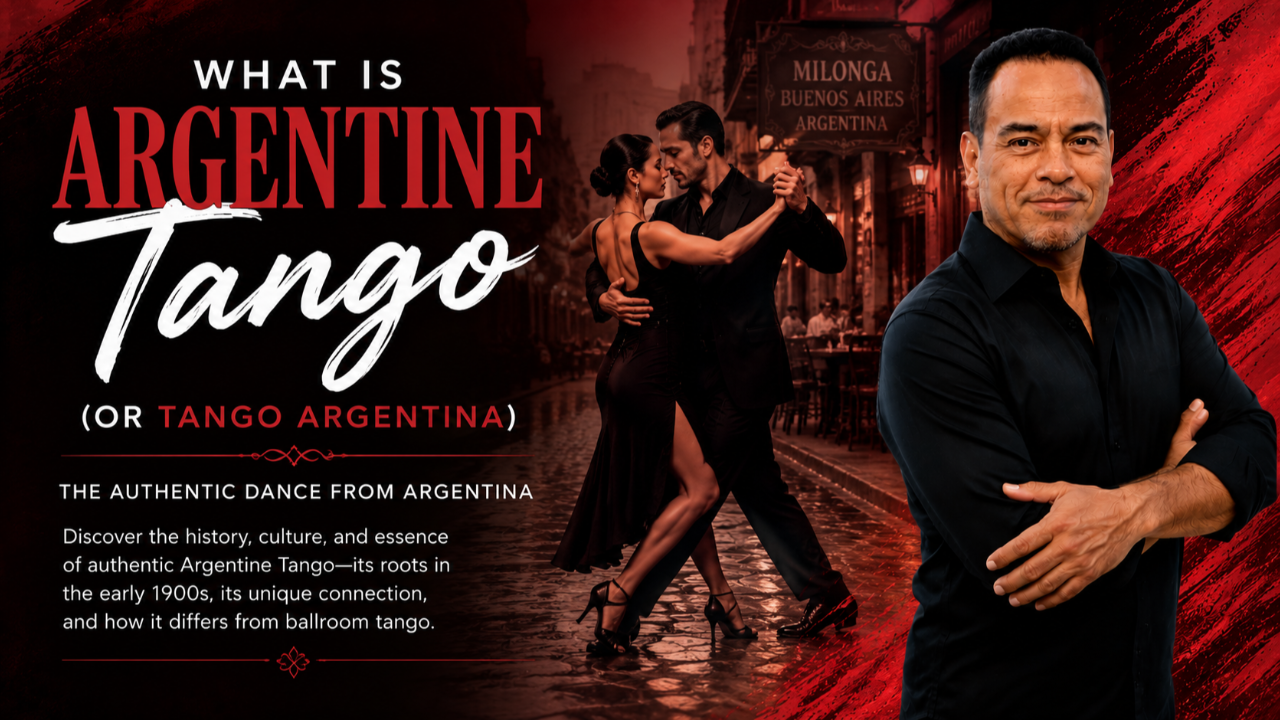
If you've ever searched “What is Argentine tango?” or “tango Argentina,” you may have seen dramatically different versions of the dance.
Some people picture sharp head movements, dramatic poses, and a highly choreographed ballroom dance. Others picture two people walking together in a close embrace, improvising to traditional tango music.
Both may be called tango, but they are not the same thing.
Argentine Tango is the original social dance that developed in the Río de la Plata region, particularly Buenos Aires, Argentina, during the late 19th and early 20th centuries. While Uruguay also played an important role in tango's history, Buenos Aires became one of its most recognized cultural centers.
Authentic Argentine Tango is fundamentally an improvised partner dance based on connection, walking, balance, musicality, and communication between two people.
It is very different from the forms commonly known as American Tango and International Tango, which developed later within ballroom dance systems.
As someone who teaches Argentine Tango, I believe understanding this difference is one of the most important places to start.
Where Did Argentine Tango Come From?
Argentine Tango developed in and around Buenos Aires during the late 1800s and early 1900s. It grew out of a mixture of cultures, music, immigration, and social life in the Río de la Plata region.
The dance evolved over time in neighborhoods, social gathering places, and eventually in dance halls and milongas.
A milonga today generally refers to a social event where people gather to dance Argentine Tango.
Unlike a dance that was originally created around a standardized syllabus, Argentine Tango developed as a social and improvisational dance.
That is one of the reasons it continues to evolve.
Different dancers, orchestras, teachers, and generations have contributed to its development while maintaining many of the essential principles that make Argentine Tango unique.
What Makes Argentine Tango Different?
When people first watch authentic Argentine Tango, they often notice the intensity and connection between the dancers.
But Argentine Tango is not simply about looking dramatic or performing difficult moves.
At its core, the dance is about two people communicating through movement.
The dancers are constantly making adjustments based on:
-
Balance
-
Posture
-
Connection
-
Walking
-
Musicality
-
Lead and follow
-
Space
-
Energy
-
Awareness of each other
Unlike memorizing a long routine, Argentine Tango can be improvised.
The leader does not simply pull or force the follower through movements. Instead, the partnership develops a physical conversation.
The leader proposes information through the connection.
The follower interprets and responds to that information.
Both partners contribute to the quality of the dance.
When the connection is working well, Argentine Tango can appear smooth, effortless, and almost conversational.
Argentine Tango Is Not Ballroom Tango
One of the most common misunderstandings is assuming that Argentine Tango and ballroom tango are the same dance.
They are not.
Ballroom tango styles, including American Tango and International Tango, have their own techniques, structures, styling, and competitive traditions.
They can be exciting and beautiful dances in their own right.
However, authentic Argentine Tango developed through a different social and cultural tradition.
Argentine Tango
Argentine Tango generally emphasizes:
-
Improvisation
-
Walking
-
Connection
-
Musical interpretation
-
Navigation around other couples
-
Communication between partners
-
Individual expression within the partnership
American and International Ballroom Tango
Ballroom tango generally follows a more standardized dance framework and has developed its own distinctive styling, posture, technique, patterns, and competitive presentation.
The movements and appearance can sometimes look more dramatic, sharp, or choreographed to the casual observer.
That is why someone searching for Argentine Tango lessons should understand which type of tango they are actually learning.
If your interest is in the traditional social dance associated with Buenos Aires and the Argentine Tango culture, you want to look specifically for Argentine Tango.
Is Argentine Tango Always Danced in a Close Embrace?
No.
One of the beautiful aspects of Argentine Tango is that the embrace can change depending on the dancers, the music, the movement, and the style being danced.
Some couples dance in a very close embrace. Others create more space between their bodies.
However, regardless of the style of embrace, connection remains essential.
The goal is not simply to hold onto your partner.
The embrace becomes part of the communication system between two people.
This is one reason Argentine Tango can feel very different from simply learning a sequence of steps.
Is Argentine Tango Choreographed?
It can be, especially for performances.
But social Argentine Tango is primarily an improvised dance.
That does not mean the dancers are making random movements.
Improvisation requires understanding.
A dancer needs to understand their balance, movement, connection, musical timing, and how to communicate with a partner.
The better those foundations become, the more freedom the dancers have to improvise.
This is one of the reasons I encourage students not to focus only on collecting more and more moves.
A dancer can know many patterns and still struggle to dance comfortably with another person.
On the other hand, someone with a strong foundation can often create an enjoyable dance using relatively simple movements.
What Does Argentine Tango Feel Like to Dance?
This is difficult to fully explain until you experience it.
Argentine Tango can feel like a combination of:
Walking together. Listening. Communicating. Balancing. Responding.
The music influences the movement, but the two dancers are also constantly aware of each other.
There may be moments of stillness.
There may be simple walking.
There may be turns, pivots, pauses, or more complex movements.
The important point is that the dance should develop through the connection rather than simply performing a memorized routine.
For me, this is one of the things that makes authentic Argentine Tango so fascinating.
Two different partners can dance to the same song and create a completely different experience.
Can a Complete Beginner Learn Argentine Tango?
Absolutely.
You do not need previous dance experience to begin learning Argentine Tango.
You also do not need to arrive with a partner.
However, I believe beginners should start by developing the right foundation.
Before worrying about complicated figures, students should begin understanding the essential principles behind the dance.
My own approach to teaching Argentine Tango focuses on progressively helping students understand the movement rather than rushing them through a collection of patterns.
Over time, I break down the details of:
-
Movement and walking
-
Balance
-
Body awareness
-
Partner connection
-
Lead and follow
-
Music timing
-
Ocho's
- Molinete
-
Technique
Later, these fundamentals can support more advanced movements and improvisation.
In future articles, I'll explore more specific Argentine Tango topics, including the six basics of Argentine Tango, improving partner connection, developing better balance, and exercises that can help prepare your body for tango movement.
Experience Argentine Tango Before You Commit
If you're curious about what Argentine Tango is but aren't ready to commit to a full course, one of the best ways to learn more is to experience it in person.
I host a monthly Argentine Tango Practice Lounge every fourth Saturday of the month, designed to give newer dancers and those familiar with the basics an opportunity to practice, learn, and become more comfortable with the dance.
It's an affordable way to spend time around Argentine Tango, practice with others, and continue developing your understanding of the dance.
Want to Learn Argentine Tango Faster?
If you're serious about learning Argentine Tango and would like more personalized instruction, consider taking private lessons with me.
Private lessons allow me to evaluate your current ability, understand your goals, and work more specifically on the areas that can help you progress.
Whether you're a complete beginner, someone with previous dance experience, or a dancer who has taken tango lessons elsewhere and wants to improve your foundation, private instruction can provide a more focused path.
The best way to truly understand Argentine Tango, however, is not just to read about it. It's to experience it.
- Maestro Marcelo

